It was all but obvious that this cause of chronic pain was going to be mentioned, having suffered from it for the best part of almost 6 years.
Pudendal Neuralgia (PN) and Pudendal Nerve Entrapment (PNE) is pain in one or more areas innervated by the Pudendal nerve or one of its branches. These areas include the rectum, anus,urethra,perineum, and genital area.
In women this includes: clitoris, vulva,lower 1/3 of the vagina and labia.
In men this includes: Penis and scrotum.
Pain can also affect other areas around the pelvis.
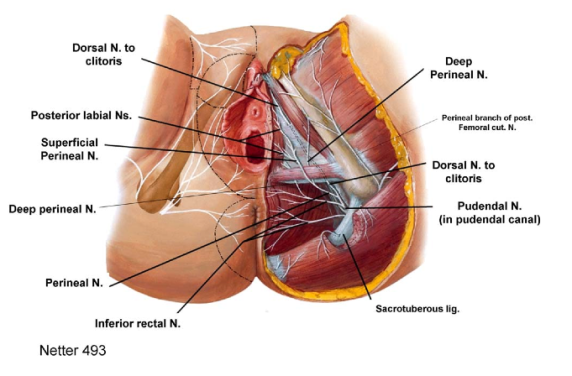
The images I am going to use in this post were for me the best way to describe exactly where the pain is. The image above (as TMI as it looks it needed to be put there as for me it is important to see the area which is affected, it shows the Pudendal Nerve on the right hand side which happens to be exactly where my pain ultimately lies however it is important to mention that some people have compressed nerve bilaterally so basically the same area symmetrically on the other side. For me it effects the whole of the right side where you can see the nerve provides messages to the whole of the perineum which includes being affected by bowel movements and pelvic movements of any sort.
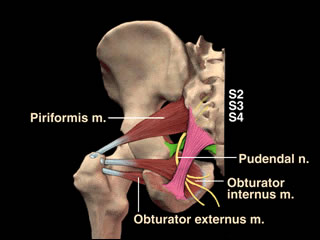
Specialist consultants have concluded that if they suspect the pain to be PNE (Pudendal Nerve Entrapment) If you look at above image you can see how the Pudendal nerve travels between the two ligaments and can get trapped usually through cycling a lot, long and problematic child birth ( which was what happened in my case), an injury, fall or many other reasons. There is a possibility that you can decompress the nerve and allow it to heal by cutting the two ligaments (coloured pink and green in the above image).It is important to stress the surgery does come with risks and is only carried out as a last resort. The success rate of this is approximately 70% in which 30-40% is basically any improvement from excruciating pain before the surgery. There is a website with all the info about the procedures it is http://www.pudendalhope.info. I would like to add that everything I mention is based on my own experience and the experience of some of the lovely people on my PN Facebook group whom I refer to as my PN family because they really are just that.
Some of the consultants mentioned as good are as follows:
- Dr Ansell (huston I think)
- Dr Hibner (Arizona)
- Dr Roberts (Nantes,France)
- Dr Dixon (Bristol,England)
What the pain feels like?
Here are some of the ways in which it is described, the first few are mainly of how the pain feels to me.
- It varies from a 2/10 to a 8/10
- The best way I can describe it so that women can relate to it is, as if you’ve just given birth and it feels pretty much bruised, sore, burning sensation only for us it’s all the time.
- A stabbing pain (feels like you’re being poked by a needle).
- Sometimes it carries down your leg like pins and needles.
- Feels like you have a foreign body stuck down below.
- Straining on a bowel movement creates a flare up.
- Makes it impossible to get up some days when the flare up is really bad as the only relief you can possibly get is by lying down.
- If anyone is reading this who has PN please feel free to add your own views on how the pain is in the comment section.
Symptoms of PN
- Main symptom is that sitting becomes unbearable.
- Sitting on a toilet seat or a doughnut pillow of some sort helps alleviate the pain (trust me my kids call the toilet room by new “go to room”). Only people with this dreaded pain can understand having to work a hard day with this pain and the appeasement when you get to go to the toilet and sit down on the toilet seat. The relief, honestly it seems preposterous but sometimes it feels like heaven. ( a bit like the ” aah bisto” feeling I think only my UK friends will get that lol).
- Any strenuous activities (the pain is often not immediate but delayed and continuous and stays long after one has finished the activity that was the cause of the pain (cycling, walking, aerobics, household chores…
- Pain is often lower in the morning when you wake up and increases through out the day.
- Area of the pain is mainly the perineum ( I hated the trips to consultants who were often male for me as there were a meager amount of female doctors specialized in this field. I mean how was I a lay person supposed to explain to them without feeling embarrassed exactly where my pain was. That is why after my first trip to the gynecologist I decided that evening to learn all the scientific names of all my embarrassing areas, it was time to come to terms with where my pain was and be all professional about it. Trust me over the years I have actually become almost immune to the embarrassment of it all).
- Intolerance to tight pants.
- Constant pain even when standing or lying down at a flare up. ( for me it would ease up if I lied down, the time it took would depend on the severity of me flare up).
- Problem with urinary retention. Sometimes it would just leak straight after you have been to the loo.
- Many complained about pain or even spasms after a bowel movement.
- Constipation.
- During and after intercourse.
- many more…..
Pudendal Nerve Decompression
I have finally after 6 years , 3 years of which took convincing the NHS to fund the procedure. I will go through my NHS journey in a later blog as it is an interesting journey in itself.
The decompression is done in many ways mainly 4 ways which again you can find out about on the pudendal hope website. Here I can only talk about my experience. I am under the wonderful consultants Dr Dixon and Dr Greenslade at Bristol Southmead hospital. I live in Birmingham which is about 2hrs drive from Bristol however there were no consultants that specialized and were experienced in the decompression of this particular nerve. I was lucky to have found Dr Greenslade through the Pudendal Hope website and he performed a diagnostic nerve block which came out positive, I was then referred to Dr Dixon as I had a few prolapse issues too. Cut a very long story short they decided to use the Transgluteal Approach as this gave the best visualization of the nerve.
Essentially the surgery was carried out with me placed under a general anesthetic faced down with my hips flexed and surgery performed by division of the sacrotuberous and sacrospinous ligaments on the one side (that’s the pink and green one in the image above). This allows us to define the Pudendal nerve and decompress its path. The ligaments are not repaired and the wound is then closed.
The rest is up to my nerve, in my case the did find it quite compressed and said now that they have freed it up I need to allow it time to heal. The consultant said to give 12-18 months in which to show improvement.
I am now on Day 7 of the surgery and I am good in terms of the cut and I will be going through my journey in my blogs.
I think this just about sums up the PN saga. Sorry for going on.
.
 Me,Myself and Life.